
Positional components on offense in a 4-2-3-1
Center Backs:
Center backs must be competent and confident on the ball. On a goal kick or ball in the goalkeepers hand the center backs look to split in order to receive a short kick or roll. They must then make the first pass in the offensive sequence, we want to avoid a square pass to the partner cb with the ball ideally moving to a full back in a high and wide position or into one of the two defensive midfielders. In some cases a pass back to the supporting keeper might be the solution but only if the keeper is supporting at a deeper and is looking to switch the play.
Once the first line of pressure is broken cb’s must then step to support the midfield or slide to support the fullback at a deep angle, hips open to the field so the ball can move onto the other side of the field or back to the gk to restart the play. Cb’s are in a very advantageous position as they can see the entire field, they have to be able to read situations developing in front of them and know when and how to support their teammate. A cb receiving a pass during a teams offensive sequence means that the team is looking to maintain possession and a switch of play is needed usually.
A good cb will always be able to identify where the space is to dribble or pass, and have the ability to execute a range of passing similar to a central midfielder.
Fullbacks:
Fullbacks are very important in this formation as the provide the width for the team. When playing out from the back fb’s will find themselves playing with their heels on the touchline supporting their central midfielders and cb’s. As the ball travels across the formation fullbacks will usually be tasked with supporting their midfielders by providing an outside passing option. This helps the team to retain possession as well as stretch the opposition creating interior spaces for the team to play in.
Good attacking fullbacks providing width and depth on the wing allows teams to play with inside forwards or inverted wingers. Fullbacks will be tasked with over or under lapping their wingers into space as the team attacks to unsettle the defense as a decoy run or to deliver a final ball. Active fullbacks create overloads in the attacking areas on the field and add an extra dimension to the attack.
Players in this position need to be confident on the ball, ability to beat players 1v1, have a good range of passing, and deliver crosses / a final ball.
Holding Mid
Holding midfielders will be dynamic all round midfielders than can tackle as well as distribute. This is a crucial partnership at the heart of the 4-2-3-1 where you will find your most versatile and confident players. This will be the base that you offense plays off of as they sit just behind the attacking midfielders providing support while under pressure and look to switch the point of attack. In a double pivot the midfielder on the side that is attacking will step with the attack into an ‘8’ role while the partner slides into a traditional ‘6’ role on the field sweeping up danger in front of the cb’s.
These players must be able to adapt to the different stages of the game as they are asked to support defenders playing out from the back, be an outlet to the wingers and fullbacks out wide, link the play moving left to right, and recycle possession as the team looks to maintain possession. These midfielders have a lot of defensive responsibility and share the load in terms of keeping the attack ticking over and can create when the opportunity presents itself.
Holding midfielders must be extremely comfortable on the ball, excellent range of passing, ability to receive the ball facing their own goal, break lines of pressure, and high work rate.
The Ten
The ‘10’ in this formation is the most creative of the three midfielders and is responsible for maintaining possession and feeding the wingers and forward. This player usually looks to find a pocket of space between the lines of the defensive formation as the attack builds. As the team plays out if the back the 10 can find themselves dropping deep to receive and relieve pressure but usually would be asked to stay higher than the pivot in order to give them an out bal as we look to move the ball forward.
The 10 has a lot of freedom in the attacking third using creative instincts to navigate very compact areas on the top of the oppositions penalty box. Depending on the player, the 10 might be asked to exclusively feed running strikers and wingers, and in some instances may be asked to run beyond the striker or fill the gaps between the 9,7, and 11 acting as a second striker. On a ball played wide the 10 should find themselves in and around the box looking for service.
The 10 must be comfortable in tight spaces, able to play a variety of passes to break lines and get in behind defenses, excellent 1v1 player, and have an eye for goal.
Wingers
Wingers may be asked to play in a traditional (right foot right side) ort inverted (left foot right side) role. These players are the teams outlets, working with fullbacks to provide width and depth to break pressure, switch the play, and get into the opposition half of the field. These players must look to take offensive risks and are tasked with advancing the play whether it be a dribble or pass.
With the ball on the opposite side of the field wingers are asked to tuck in to occupy vacant space to be available as the ball moves left to right or right to left with a fullback overlapping to continue the move and get deeper into the attacking half. When the ball is on their side wingers can look to get in behind their fullbacks attacking the space between their marker and the cb with either the ball or the run occupying that space. Once the defensive line is broken wingers will look to serve into the box or head to goal themselves.
Wingers must be able to beat their marker 1v1, play combination passes, efficient crossers, have an eye for goal, and have good off ball movement.
Striker
The lone striker in a 4-2-3-1 has to be a complete center forward. The role of this forward may change many times within a game. The striker may be tasked with making runs in behind a high line or drop into the midfield to hold the ball and allow runners to go past. Strikers may be asked to pull wide left or right to find space as they will most likely be outnumbered by the cb’s 2 to 1. Other times the striker may just be used as a decoy in buildup play but will eventually be tasked with being a poacher as the ball gets into the box and finish moves off.
Along with wingers, the striker is also looked at as an outlet to break pressure and should always be looking to run onto the ball whether that is behind the defense or in front of it. A striker with good movement will always buy themselves a yard or two of space from a defender.
Main Focus:
Break Lines Early and Then Relieve Pressure with a Drop
Regain possession quickly when lost
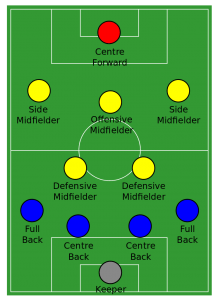
The 4-2-3-1 splits players into four bands. The defensive unit consists of the standard centre-backs and full-backs and two defensive midfielders screening them, often called the ‘double pivot’.
The attacking unit consists of a band of three attacking midfielders and a lone central striker. The wide midfielders are generally fast dribblers who like to cut inside or make runs into the box. The attacking central midfielder, often the ‘No. 10′, is normally a creative passer who can play balls into the feet of either the wide attackers or the lone striker.

Pros
A good 4-2-3-1 is a formation that has a wonderful ‘springy’ quality – it absorbs pressure without breaking and then snaps back with surprising force.
In defence the 4-2-3-1 covers space very effectively, with the band of three and the lone striker able to press the opposition high up the pitch while the two defensive midfielders ensure that there is no space left in front of the defence. Then the back four can either play a high line, compressing the space even further, or drop deeper as preferred.
Once the ball is won back, often by the defensive midfielders, the 4-2-3-1 can spring into attack.
The full-backs can surge up the wings in the knowledge that the defensive midfielders can drop into the space left behind if needed. As they come up the wings, the wide attackers come inside and they tend to be fast dribblers who look to get into the box. The attacking central midfielder, often the ‘No. 10′ who is the most creative player on the team will look to play them or the lone striker in via fast passing combinations.
Cons
While at its best the 4-2-3-1 is a masterpiece of flexibility, when played poorly it can be slow and cumbersome.
If the midfield bands are forced back and compressed into a 4-5-1, the striker can be left isolated with very little support. The full-backs, key to modern attacking football, can also be trapped behind their midfield line.
Or the opposite may happen, where the attacking band of midfielders neglect to track back and help their full-backs, allowing opposition wide players to overload the defence. This is similar to the possible problems in a 4-3-3, if the attacking wide players forget their duty to help the team when out of possession. However it can be even more pronounced as the two defensive midfielders are left with a huge amount of the pitch to cover
Double 6’s
The “double six” is often interpreted in the following way as part of this system of play: one of the “sixes” is more offensively oriented, is often unmarked in the midfield and thus can be passed to, additionally takes care of the playmaking and secures the rear space behind number 10 if his team is in possession of the ball. The second “six” is mostly responsible for defensive tasks. Ideally, the two players swap their roles in the system of play time and time again, in order to become less predictable.
In the defensive, the “sixes” may easily form triangles with two players of the “four back” on their sides and thus heavily attack the opposing player in possession of the ball. Gaps for possible passing routes are automatically closed in the process and if possession of the ball is won, it is easy to find access to the wing players in the midfield. However, the running paths are often very long as described above and it is often hard to support the wing-backs.